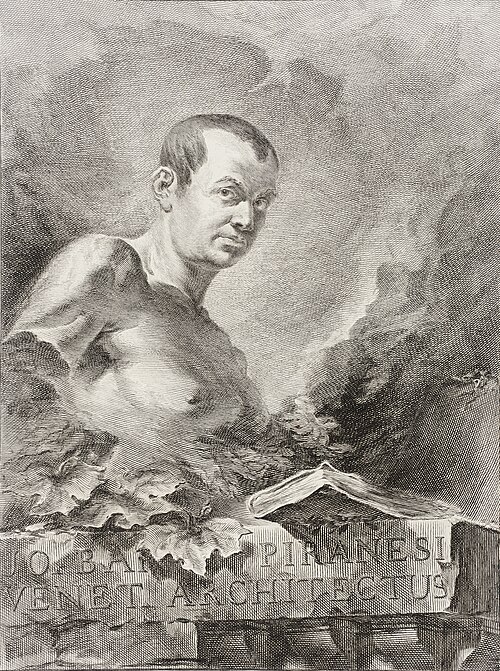
Part engraver, part archaeologist, part scholar, part artist—it is Piranesi's eclecticism that makes his works so fascinating. Piranesi likely developed this jack-of-all-trades side during his childhood.
He was born in Venice in 1720; his father was a stonecutter, a title that encompassed the trades of mason, master builder, and sometimes even architect. His uncle, meanwhile, was an official architect, and it was with him that Piranesi began his apprenticeship. However, he did not finish it, preferring to study drawing and engraving. He also initiated himself into classical studies thanks to his brother, who had become a Carthusian monk. After producing a few engravings and creating theater set designs, he was 20 years old when the Venetian government offered to send him to Rome as part of a diplomatic mission to pay tribute to the new pope. Piranesi seized the opportunity to visit a city he knew only through reproductions. Ultimately, he chose not to return to Venice, preferring to continue his training as an engraver under one of the city’s masters of etching: Vasi. It was in his workshop that Piranesi developed a great interest in the representation of ruins, notably through working on a major publication on ancient Rome that was then being prepared in his master's workshop.
In 1743, Piranesi emancipated himself and began publishing collections of views of Rome under his own name. In them, he demonstrated a strong interest in architecture, which appealed to travelers undertaking the "Grand Tour" who wished to keep a souvenir of their discovery of the city. This allowed Piranesi to save enough money to undertake a journey across Italy. It was during this trip that he began working on one of his major collections, The Prisons (Le Carceri).
Upon returning to Rome in 1747, he began one of his most famous series: Views of Rome (Vedute di Roma). Each large-scale plate depicts a location in Rome. But what makes this series so powerful is its pictorial dimension. Indeed, until then, the veduta genre (the highly detailed representation of an urban landscape) existed exclusively in the form of paintings. Piranesi's goal was therefore to show that etching, when thoroughly mastered, could create all the nuances necessary to produce such works.
His series met with great success, which allowed him to buy a house on the Corso, a location very popular with travelers. The ability to maintain a steady income by reprinting the plates of the Vedute di Roma allowed Piranesi to devote himself to another of his passions: research into Antiquity. He participated in excavation projects, made surveys, and compiled extensive documentation on Roman ruins. His grand project then became to create an illustrated plan of ancient Rome, but the endeavor seemed entirely disproportionate, and no patron was willing to finance such a risky enterprise—Piranesi’s difficult temperament likely did not help. Nevertheless, he met Lord Charlemont who, despite friction between them, helped him complete his major series Roman Antiquities (Le Antichità Romane) in 1756. This set of over two hundred plates focuses on Roman ruins. In addition to large illustrative plates, Piranesi wrote detailed theoretical texts for each image.
He was acutely aware of the fragility of these ruins and wished to engrave them so that a trace would remain. His research work gained recognition from his peers, for instance with his induction as an honorary member of the Society of Antiquaries of London in 1757. In 1761, he published the final version of The Prisons (Le Carceri) and opened a proper workshop inside his home, allowing him to self-publish. Three years later, he set engraving aside somewhat to return to his first field, architecture, with the restoration of the Priory of Malta. This would be his only known architectural realization. Made ill by the fumes of the acid he used for etching, Piranesi died in 1778, leaving behind a body of work that would heavily inspire early 19th-century romantic engravers as well as 20th-century surrealists, and—even today—many contemporary printmakers.