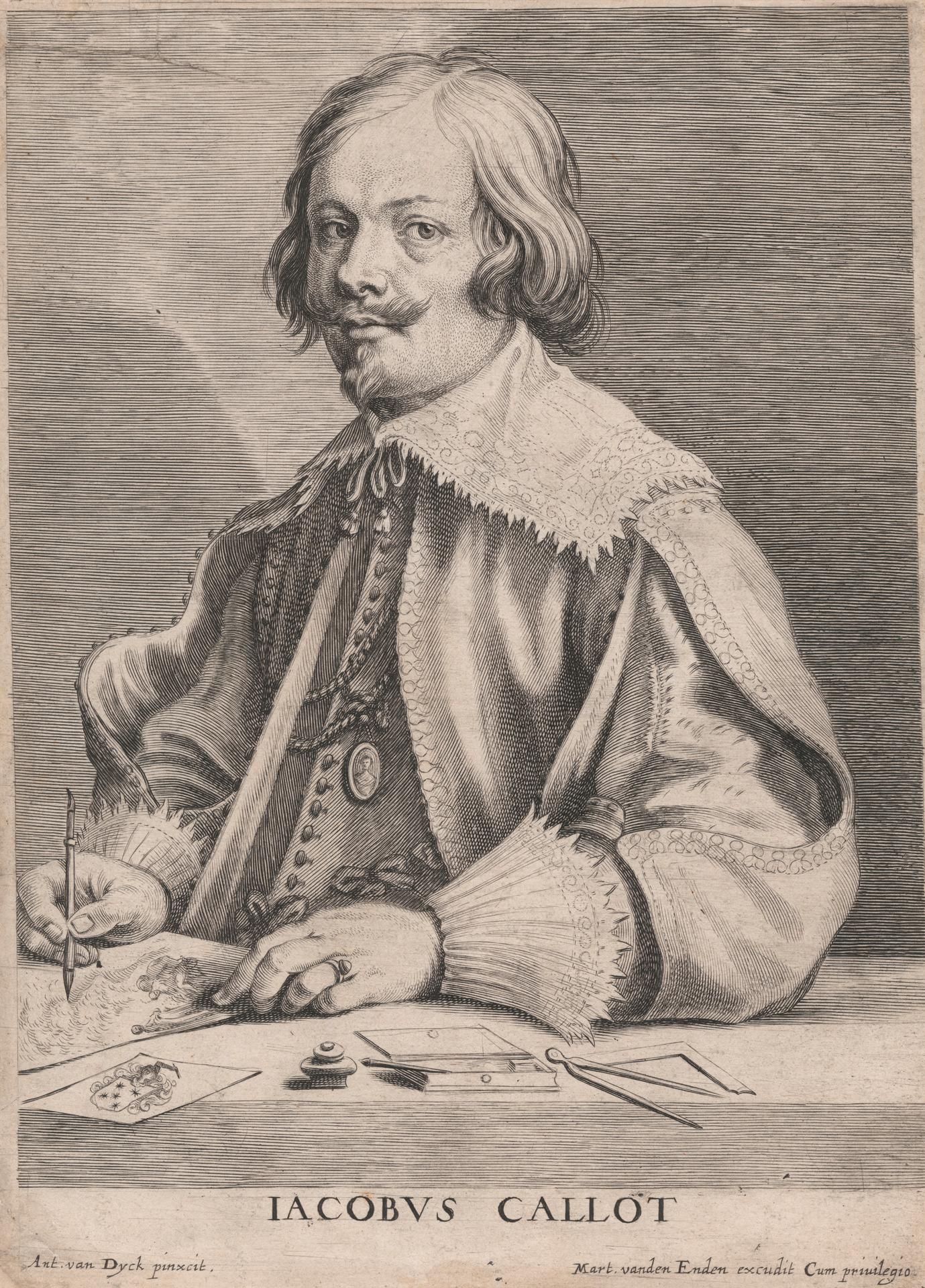
Jacques Callot is undeniably the 17th-century French master of etching. Born in Nancy in 1592 into a family of the noblesse d’épée (nobility of the sword), he was also a proud representative of the Lorraine School. As a younger son, he had the freedom to nurture his early passion for drawing. He later recounted that at the age of ten, he tried to run away to Rome with a troupe of gypsies, only to be dragged back to Nancy by his older brother. Recognizing his artistic calling, however, his father allowed him to begin an apprenticeship with a goldsmith at age 14. There, he learned how to handle the burin and, most importantly, met another great Lorraine engraver: Jacques Bellange (1575–1616).
Once his training was complete, he finally set off for Rome, where he lodged with an engraver from Troyes, Philippe Thomassin. Ultimately, he stayed only a short time in the Eternal City and, after three years, decided to leave for Florence. This proved to be the right choice, as he remained there for nearly twelve years. Most notably, in 1614, he entered the service of the Uffizi, marking the beginning of seven years of extraordinary productivity. He developed a new varnishing technique to achieve greater precision in his etchings: hard ground (vernis dur). Thanks to this innovation—inspired by the city's cabinetmakers and luthiers—he was able to create increasingly intricate engravings. It was in this way that he produced one of his greatest prints: The Fair at Impruneta, featuring a thousand figures.
In 1621, however, the newly crowned Duke of Lorraine, Charles, invited him to become a court artist. Jacques Callot accepted and returned to his homeland. There, he led a quiet life, got married, and engraved his Grotesques series. His reputation spread beyond borders, and in 1625, he was invited by the Infanta of Spain to the Netherlands to engrave the Siege of Breda. He spent a few months in Leuven and then Brussels, where his portrait was painted by Anthony van Dyck. His depiction of the Battle of Breda was so successful that in 1629, King Louis XIII of France invited him to engrave the Siege of La Rochelle. Jacques Callot completed the plate, but hastily returned to Nancy, where the political situation was growing increasingly volatile.
Indeed, Louis XIII's troops were threatening the region, and the duchy was conquered in 1633. The King of France then tried to persuade Jacques Callot to work for him, but the artist responded with The Great Miseries of War (Les Grandes Misères de la Guerre), a series of prints depicting the worst atrocities committed by the royal army in Lorraine. It would be his final major work before his death in Nancy in 1635.