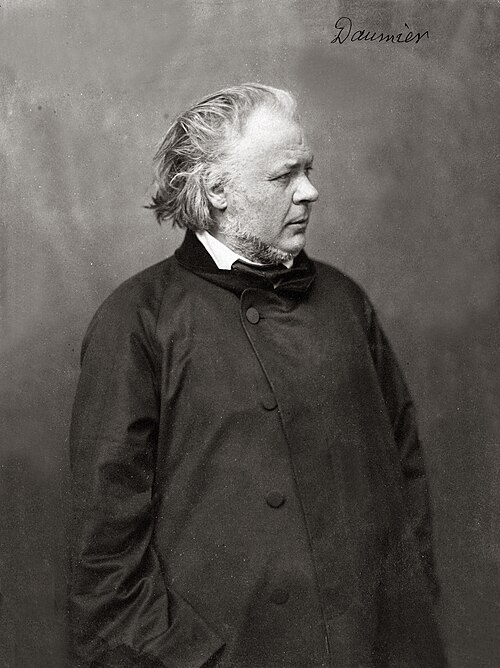
Honoré Daumier is the most prolific and probably one of the most talented caricaturists of the 19th century. Born into a family of merchants from Marseille, his father soon gave up financial stability to pursue a writing career in Paris. However, this proved to be a failure, and Honoré Daumier grew up in a certain degree of financial hardship. Consequently, he began working around the age of 12 to help support his family. He found a job as an office boy for a bailiff, and two years later, began working in a bookstore.
What truly drove him, however, was drawing. He faced opposition from his parents, who could not afford to lose his income. Fortunately, he was spotted by Lenoir, director of the Musée des Monuments Français and a friend of his father. Lenoir managed to persuade Honoré's parents to take him on as a pupil. But this training proved too traditional for the young man, who quickly grew tired of copying classes at the Louvre. He abandoned his training and found a job in one of the lithographic workshops starting to open in Paris. Thus, in 1829, he began publishing a few caricatures and was noticed by Philipon.
This publisher and art lover wanted to launch a new journal amidst the incandescent political context of 1830. This journal would be La Caricature, and Daumier joined the venture alongside big names like Grandville and Balzac. In 1832, however, Philipon was sentenced to six months in prison for lèse-majesté, and upon his release, he founded a new journal, Le Charivari. He conceived of caricatures as an integral part of his paper, always reserving a full page for them. This intense output allowed Daumier to hone his craft, particularly in mastering the new tonal possibilities offered by lithography, which was then a relatively new medium. Day after day, the caricaturist illustrated political events as well as interpersonal relations, thereby offering a window into the evolution of early-to-mid 19th-century society, especially regarding class and gender dynamics. His core political stance was republicanism, which he maintained despite the country's political ups and downs.
In 1848, however, he decided to stop making caricatures to return to one of his first passions: painting and sculpture. Unfortunately, he was unable to make a living from his art and failed to return to La Caricature. Though he died in poverty in 1878, his works were progressively rehabilitated throughout the 20th century, making him today a major figure in caricature and lithography.