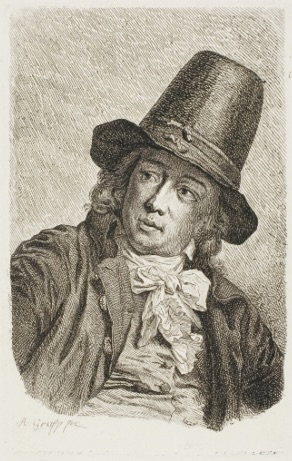
The information we have on the life of Abraham Bosse is rather limited. Even his exact date of birth is uncertain. He was born in 1602 or 1604 in Tours into a modest family of local tailors of German origin.
What is certain is that in 1620, young Abraham began an apprenticeship in Paris with the engraver and publisher Melchior Tavernier. The exact circumstances of their meeting have yet to be established, with Protestantism being the only known link between master and apprentice. He thus began his training in burin engraving and etching at a time when this was far from standard practice. Indeed, in the 1620s, Paris lagged far behind in the mastery of intaglio (taille-douce), while woodcut—which allowed for the rapid production of large print runs—remained dominant. At the time, the Netherlands was the leading center for burin engraving, which may explain why, in an era when Italy influenced much of Europe, Abraham Bosse turned toward Northern art.
Drawing inspiration from their way of depicting everyday life, he achieved his greatest successes with genre scenes. He portrayed moments from the lives of the Parisian bourgeoisie, most often set in meticulously reproduced interiors, thereby opening a window into the daily lives of his contemporaries. His visual accounts are so vivid and accurate that they still serve today as essential references for historians and specialists in the history of fashion and furniture. His compositions are always carefully structured, with anonymous figures arranged as if on a theater stage—an effect sometimes heightened by a curtain in the corner of the image. His prints were conceived like small paintings, both in their format and in their framing by an ornamental border.
What also gives the viewer the impression of stepping directly into the space is Abraham Bosse’s great mastery of perspective. Starting in 1641, he began regularly attending the workshop of Girard Desargues, who gave lectures on linear perspective, of which he was a staunch advocate. Abraham Bosse allied himself with Desargues in this cause, first by developing a genuine mathematical command of the subject, and also by illustrating Desargues's treatises.
From 1645 onward, he gradually stepped back from printmaking to devote himself to teaching, notably through the publication of theoretical treatises such as Traité des manières de graver en taille-douce (On the Manner of Engraving with Etching and Burin) and three treatises on linear perspective. His fierce defense of this method even led to his expulsion from the Académie Royale de Peinture et de Sculpture in 1661, despite having been the first printmaker admitted thirteen years earlier. Yet these disputes with advocates of a more intuitive perspective—of whom Charles Le Brun was one of the most prominent representatives—did nothing to diminish his success. By the time of his death in 1676, he was a widely copied printmaker, respected as much for his artistic output as for his efforts in passing down the art of engraving.