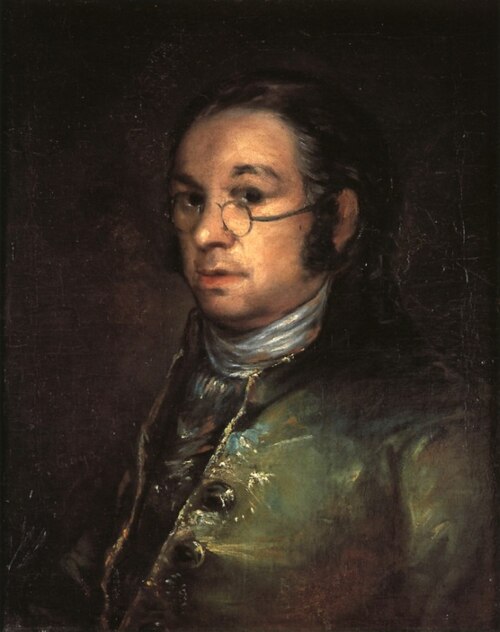
Francisco de Goya is an artist who straddles two centuries (the 18th and the 19th) as much as two worlds (academicism and the fantastical). Born in Zaragoza in 1746, his father, a gilder, quickly spotted his drawing talent and sent him to apprentice with a local painter. Goya trained diligently there, and at age 17, applied for a scholarship from the Royal Academy of Fine Arts of San Fernando in Madrid, only to fail rather miserably. When he tried his luck again two years later, the result was the same: not a single person voted for him. Yet Goya did not give up and traveled to Rome for a few years to refine his training.
Upon returning to Zaragoza, he gained a degree of local recognition as a painter and received several commissions for major buildings in the city. He also married the sister of painter Francisco Bayeu, who helped Goya secure a position as a cartoon designer at the Royal Tapestry Factory. The young couple moved to Madrid, where the painter was able to hone his craft by studying the royal collections. Around the age of 35, his personal style firmly took shape. In 1780, he finally succeeded in gaining admission to the San Fernando Academy and secured several major commissions for churches in the city. During this period, he also grew closer to the royal family through the king's brother.
In 1786, he was appointed Painter to the King, and in 1788, Court Painter (Pintor de Cámara). Although a severe illness left him deaf in 1792, he became director of the San Fernando Academy in 1795. This appointment marked the start of a remarkably fertile creative period, during which he etched Los Caprichos (The Caprices). Benefiting increasingly from private patronage, he had the freedom to assert an ever more phantasmagorical style, populated by grotesque figures, witches, and unsettling creatures.
However, the start of the Napoleonic invasion in 1808 ushered in a deeply dark period. Goya, who had taken a keen interest in Enlightenment philosophy, found himself torn over the atrocities committed by the French army against Spanish soldiers and civilians. From this experience, he created The Disasters of War (Los Desastres de la Guerra), a series of eighty-two prints depicting almost unbearable violence. Even though 1814 marked the end of the war, Goya remained permanently scarred by those years. He nevertheless etched La Tauromaquia, a more lively series that stood apart from his otherwise bleak output. In 1819, he bought a house just outside Madrid, on whose walls he painted his famous Black Paintings. It was during this period, marked by profound pessimism, that he produced his final major print series, Los Disparates (The Proverbs or The Follies)—the most hermetic and difficult-to-interpret part of his oeuvre. In 1823, facing the return of absolute monarchy, which threatened him over his liberal ideas, he decided to leave for France. After a stay in Paris, he settled in Bordeaux, where he experimented with lithography before dying there in 1828.